How to play Ludo Duo
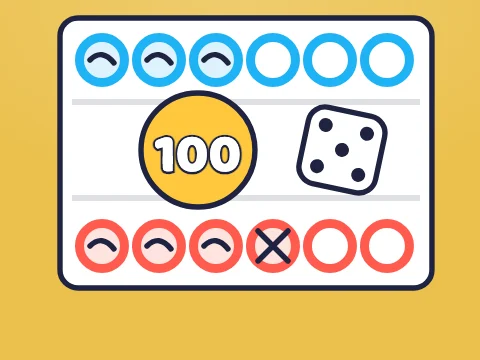
- Roll the die on your turn and move one token that many squares.
- Roll a six to bring a token out of base; a six also earns another roll.
- Land exactly on a rival token to send it back to its base.
- Stop on safe squares when a rival is close behind you.
- Get every one of your tokens home before your rival does.
Ludo Duo rules
Standard Ludo, the board and setup
- The board is a cross-shaped track of squares round a central home, with a coloured base in each corner. Each player picks a colour and puts 4 tokens in that base.
- Players take turns clockwise, rolling one six-sided die. Many families decide who starts by having everyone roll once; the highest roll goes first.
- With only 2 players, the usual habit is to take bases in opposite corners so both tokens race the same distance without starting next to each other.
Standard Ludo, rolling and sixes
- A token can only leave base on a roll of 6. It moves onto its colour's start square.
- Rolling a 6 gives you another roll after your move.
- Three sixes in a row is the rule most people search for. In the common rule, the third six is cancelled and your turn ends without a move. Some households also send the token back; agree on it before you start.
- If no token can use the roll, the turn passes.
Standard Ludo, captures and safe squares
- If your token finishes its move on a square holding a rival token, the rival token is captured and goes back to its base. It needs another 6 to come out.
- Squares marked with a star, and each colour's start square, are safe in most Indian rule sets: nobody can be captured there.
- Many house rules add a block, often called a double goti: two of your tokens on one square form a wall that rival tokens cannot pass or capture. Not every rule set uses it.
- Some groups award an extra roll for a capture. This is a house rule, so settle it at the start.
Standard Ludo, entering home
- After a full lap, each token turns off the shared track into its own coloured home column, where rivals cannot follow or capture it.
- In most rules a token needs the exact number to reach the final home square. If the roll is too big, that token cannot move and you must move another one or pass.
- The first player with all 4 tokens home wins. Others can play on for second and third place.
How Ludo Duo in Duo Clash differs
- There are always 2 players and each has 2 tokens, not 4. Red starts in the bottom-left base and Blue in the top-right.
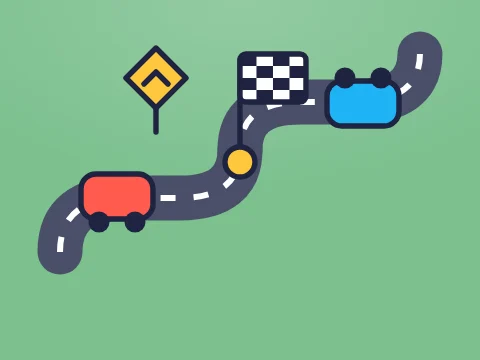
- The track is one shared loop of 40 squares, and tokens move clockwise only.
- There is no home column and no exact roll: a token goes home on whichever roll carries it past the end of its lap. Until that roll it is still on the track and can be captured.
- There are no blocks. Any token can pass over any other token. Your own 2 tokens may share a square and still move separately.
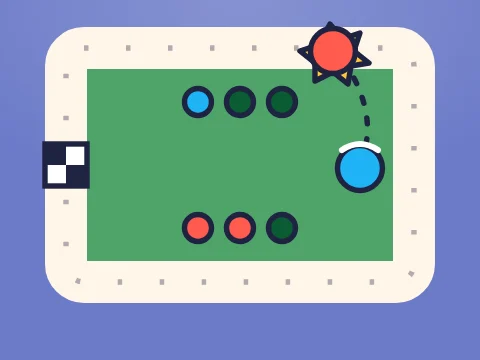
- Landing on a square with one or both rival tokens sends all of them back to base.
- Star squares and both start squares are safe, and tokens of both colours can share them.
- A 6, a capture and a token reaching home each earn 1 extra roll. A single move that does two of these still earns only 1.
- Three sixes in a row voids the third six: you make no move with it and the turn passes.
- The first player with both tokens home wins straight away. There are no draws; if a match runs far too long, the game stops it and whoever is further round the board wins.
Ludo Duo techniques, from first game to expert
Beginner
1. Bring out a second token early
With only one token on the track, every roll is a forced move, even one that drops you next to a rival. A second token means each roll gives you a choice, which is where all Ludo skill lives.
Beginner
2. Count the 6 squares behind you
A rival can only reach you with a single roll from 1 to 6 squares back. Before you move, check which squares are 1 to 6 ahead of each rival token and avoid ending there unless the square is safe.
Beginner
3. Use safe squares as rest stops
A star or a start square is a place where nothing can capture you. When a rival token sits a few squares behind you, a move that lands on a safe square is usually worth more than a longer move into danger.
Improving
4. Capture when you can
A capture costs your rival a full lap of progress and a 6 to restart. In Ludo Duo it also gives you an extra roll, so taking a token often beats racing a different token forward.
Improving
5. Hurry the token near the end of its lap
In Ludo Duo there is no protected home column, so a token on its last stretch has the most to lose. Spend your rolls getting it home before you advance the token at the back.
Expert
6. Chase from behind, not in front
A token sitting just behind a rival threatens it without being threatened, because tokens never move backwards. Holding that position forces your rival to run or take a risk.
Expert
7. Weigh the extra roll
When two moves look equal, pick the one that earns a bonus roll: a 6 used to bring out a token, a capture, or a token reaching home. The extra roll often lets you fix whatever risk the first move created.
A worked example
Here is how one early stretch of a Ludo Duo game can go, to show how the rules fit together.
- Red rolls a 4. Both Red tokens are still in base and only a 6 brings one out, so there is no move and the turn passes.
- Blue rolls a 6. One Blue token comes out onto Blue’s start square, and the 6 earns another roll. Blue rolls a 3 and, with only one token out, auto-move moves it 3 squares.
- Red rolls a 6 and brings a token out, then uses the extra roll, a 5, to move it 5 squares clockwise.
- Blue rolls a 6 again. Now Blue has a choice: bring out the second token or move the first one 6 squares. Bringing out the second token is usually right, because it gives Blue a choice on every later roll. The 6 earns another roll: a 2, which Blue uses on the front token.
- A few turns later, Red’s leading token sits 4 squares behind Blue’s leading token, which is not on a safe square. A roll of 4 would land on it and send it back to base. Red rolls a 4, captures, and earns an extra roll for the capture. That Blue token now needs another 6 to come out.
- Red’s extra roll is a 6. That earns a further roll, so Red brings out the second token and rolls again.
Notice what decided the exchange: Blue left a token within 6 squares in front of a Red token, off a safe square. Had Blue parked that token on a star square instead, the capture would not have been possible.
History and variants
Ludo comes from Pachisi, a cross-and-circle race game played in India for centuries. A simplified version was patented in England in 1896 under the name Ludo, and the game spread round the world from there. Today it is one of the most played family board games in India, and almost every household has its own small differences.
Those differences are why “Ludo rules” searches are so common. The points that change most from group to group are what happens on three sixes, whether a capture earns an extra roll, whether two tokens on one square form a block, and whether a token needs an exact roll to finish. None of these is wrong. The fair approach is to agree on them before the first roll.
Ludo Duo settles each question one way and keeps it short: two tokens each, no blocks, no home column, an extra roll for a six, a capture or a token getting home, and the third of three sixes cancelled. With half the tokens and a single shared loop, a full game fits into a few minutes while keeping the parts of Ludo that matter, the six to start and the capture that sends a rival back to base.
Where to play Ludo Duo
Duo Clash
Two players, one phone
- Two players sit at either end of one phone in a table layout and pass it between turns. Tap the dice to roll, then tap a glowing token when you have a choice of moves.
- Auto-move (on by default) plays the move for you when only one token can move. Turn it off if you want to tap every move yourself.
- A dice animation option (off by default) changes only how the roll looks. The dice are fair: one random sequence serves both players, and nothing adjusts it for streaks or the score.
- Play Bolt the bot on Easy, Normal or Hard. Easy ignores danger and often moves the wrong token, Normal watches for danger and captures, and Hard also weighs its bonus rolls and the race home.
- A new match picks the first roller at random; on a rematch the player who lost rolls first. In a tournament the first roll alternates, starting with Red.
- Ludo Duo plays offline on one phone or against the bot. It is not one of the online games. There are no hints in this game.
Questions about Ludo Duo
What is the rule for three sixes in Ludo?
In the common rule, rolling 6 three times in a row cancels the third six and ends your turn. Ludo Duo uses this rule: the third six gives no move and the turn passes.
Do you need an exact roll to enter home in Ludo?
In most standard rule sets, yes: a token needs the exact number to reach the last home square. Ludo Duo drops this rule, so any roll that carries a token past the end of its lap takes it home.
How do you play Ludo with 2 players?
In standard Ludo, each player uses 4 tokens from opposite corners and the rules stay the same. Ludo Duo is built for two: 2 tokens each on a 40-square track, which keeps a game to about 3 to 5 minutes.
What is a double goti in Ludo?
It is a house rule in which two tokens of one colour on a single square form a block that rivals cannot pass or capture. Ludo Duo has no blocks: any token can pass over any other.
Can you capture a token on a star square?
Not in most rule sets, including Ludo Duo. Star squares and start squares are safe, and tokens of both colours can share them.
Does a capture give an extra roll in Ludo?
Only under some house rules. In Ludo Duo it does: a capture, a 6 or a token reaching home each earns one more roll.
Facts checked against the game's own design documents on .