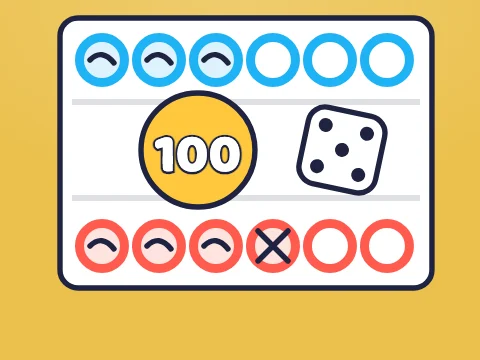
How to play Pig
- Roll the die. Any number from 2 to 6 adds to your turn total.
- Roll again to build the total, or hold to bank it.
- Roll a 1 and your turn total is lost; the die passes.
- Reach the target score first to win.
Pig rules
What you need
- One six-sided die, something to keep score with, and 2 or more players. A score sheet with one column per player is enough.
- Agree on the target before you start. 100 is the traditional target; shorter races of 50 or 30 suit a quick game.
A turn
- Your turn total starts at 0. Roll the die.
- A 2, 3, 4, 5 or 6 adds its value to your turn total. Then decide: roll again or hold.
- If you hold, add the turn total to your banked score and pass the die.
- If you roll a 1, the turn is a bust: the turn total becomes 0 and you pass the die. Points you banked on earlier turns are never lost in one-die Pig.
Winning
- The first player whose banked score reaches the target wins. In casual play you can stop the moment your bank plus your turn total reaches it.
- Going first is an advantage in plain Pig. A common fix is to give the second player one last turn whenever the first player reaches the target.
Two-dice Pig
- A widely played variant rolls two dice and adds them. A single 1 busts the turn, and a double 1 also wipes out your whole banked score.
- Doubles in this variant are risky to chase: one bad roll can cost a whole game's work.
Pig in Duo Clash
- The default race is to 50. The Race to option also offers 30 or 100, and a match can be a single game or best of 3.
- When your bank plus your turn total reaches the target, it banks by itself. You cannot hold on a turn total of 0.
- Last chance is on by default: if the starting player reaches the target, the other player gets one final turn to pass that score. Hold is switched off on that turn, passing the bank wins at once, and a 1 loses. If the second player reaches the target first, they win straight away.
- Three optional extras: Shield blocks each player's first 1 in a game (it scores nothing, but the turn goes on), Snake eyes switches to two dice where any 1 busts and a double 1 empties the bank, and Streak flame shows a flame behind long turns with no effect on points.
- Pig never ends in a draw. The first player of a new match is chosen by a coin toss, and the loser of a game starts the next one.
Pig techniques, from first game to expert
Beginner
1. Decide your stopping number before you roll
Most bad Pig turns come from deciding roll by roll. Pick a turn total where you will hold, then stick to it unless the score gives you a clear reason to change.
Beginner
2. Remember the odds never change
Every roll has a 1 in 6 chance of being a 1, however many good rolls came before it. A hot streak does not make the next roll safer; it only makes the bust more expensive.
Improving
3. Hold at about 20 in a race to 100
A roll gains about 3.3 points on average (five chances in six of an average 4) and risks your turn total one time in six. Those two balance when the turn total is 20, which is why holding at 20 is the classic rule of thumb.
Improving
4. Hold lower in shorter races
In a race to 50 or 30, each point is a bigger share of the target and fewer turns are left to recover from a bust. Bank somewhat earlier than 20, especially early in the game.
Expert
5. Push when you are behind
If your rival is well ahead, safe small banks will not catch them. Take bigger turns and accept more busts. When you are ahead, do the reverse and bank sooner.
Expert
6. Never hold short when they are about to win
If your rival needs only one decent turn to reach the target, a small bank does nothing for you. Keep rolling until you can win this turn or come very close.
A worked example
This is one turn of a race to 100, played with the hold-at-20 rule of thumb. The player has 34 banked; the rival has 51.
- Turn total 0. Roll: 5. Turn total 5.
- Roll: 3. Turn total 8. Still well under 20, so roll again.
- Roll: 6. Turn total 14.
- Roll: 4. Turn total 18. Two short of 20. At 18, a roll risks 18 points one time in six (an expected loss of 3) and gains about 3.3 on average, so rolling is still very slightly ahead.
- Roll: 2. Turn total 20. Hold. The bank goes from 34 to 54, just ahead of the rival.
Now change the situation. Suppose the rival had 92 instead of 51. Holding at 20 would leave the player on 54, and the rival needs only 8 more, which one or two good rolls will bring. Here the right play is to keep rolling well past 20, because a bust costs little when holding would probably lose anyway.
The arithmetic behind the rule of thumb is short. Five times in six a roll adds 2 to 6, which averages 4, so a roll gains 4 × 5/6, about 3.3 points. One time in six it costs the whole turn total. With a turn total of T, the expected loss is T/6. The two are equal when T is 20, so below 20 another roll gains on average and above 20 it loses on average. This is a rule for scoring points, not for winning: when the scores are far apart, winning sometimes needs a different choice.
History and variants
Pig is a traditional folk dice game; its earliest printed rules are usually traced to John Scarne’s 1945 book on dice games. Because the decision to stop rolling has a precise best answer that is hard to work out by hand, Pig is often used to teach probability in classrooms.
The two-dice version, where a double 1 wipes the whole bank, is the best-known variant. Other house rules change the target, give the second player a final turn so turns are equal, or let a player survive the first 1 of the game. Duo Clash offers the last three as options: Snake eyes, Last chance and Shield.
Where to play Pig

Duo Clash
Two players, one phone
- Both players sit facing each other with a Roll and a Hold button in their own dock. Only the mover's buttons light up, and the scoreboard turns to face whoever is rolling.
- Options: Race to 30, 50 (default) or 100; Single game or Best of 3; and the extras Last chance (on), Streak flame (on), Shield (off) and Snake eyes (off).
- Against Bolt the bot: Easy holds too early or pushes far too long, Normal holds once it has a steady total but sometimes misjudges, and Hard pushes harder when behind, plays safer when ahead and keeps rolling when you are close to winning.
- Playing the bot outside a tournament, you can spend 20 coins on a hint once your turn total is above 0. It highlights Roll or Hold for 2 seconds. One hint per turn, and none on a Last chance turn.
- Pig plays online against a stranger or a friend you invite with a short code or link. An online match is one game to 50, the server rolls the die, each turn has a 30-second clock, and running out of time counts as a bust.
- A tournament game is a single race to 50 with Last chance and Streak flame on, Shield and Snake eyes off, and no hints.
Questions about Pig
What happens when you roll a 1 in Pig?
You lose everything you rolled that turn and the die passes to the next player. Your banked score from earlier turns stays safe.
What is the best strategy for the Pig dice game?
Hold when your turn total reaches about 20 in a race to 100, a little lower in shorter races. Then adjust: take more risk when you are behind or your rival is close to the target, and less when you are ahead.
How do you play Pig with 2 dice?
Roll two dice and add them to your turn total. If either die shows a 1, the turn is lost; if both show 1, your whole banked score goes back to 0. In Duo Clash this is the Snake eyes option.
Is Pig a game of luck or skill?
Both. The dice are pure luck, but the decision to hold or roll is a real skill, and a steady stopping plan wins more often than reckless rolling.
Does going first in Pig give an advantage?
In plain Pig, yes, slightly. Duo Clash's Last chance rule, on by default, gives the second player a final turn so both get the same number of turns.
What score do you play Pig to?
100 is traditional. Duo Clash uses 50 by default and also offers 30 and 100.
Facts checked against the game's own design documents on .