How to play Code Crack
- Each player secretly sets a code of 4 different digits.
- Take turns guessing the other player's full code.
- Read the clue: solid dots for right digit, right place; rings for right digit, wrong place.
- Use every clue so far to choose your next guess.
- Crack the code first to win the round.
Code Crack rules
Setting codes
- A code is 4 digits from 0 to 9 (3 or 5 if you change the option). By default no digit repeats; an option allows repeats.
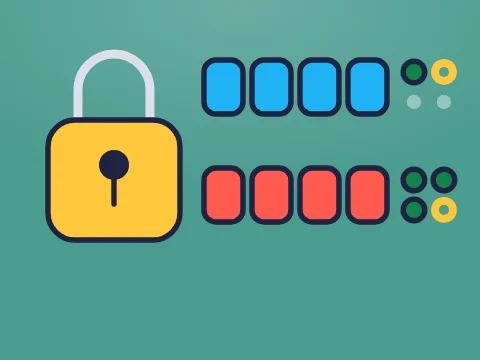
- With a friend, the starter sets a code behind a hand-over cover while the other player looks away, then the roles reverse. A locked code cannot be changed.
Guesses and clues
- The starter guesses first. A turn is one guess of a full code.
- Each guess earns one mark per digit: a solid dot for a digit in the right place, a ring for a digit that is in the code but elsewhere, and a faint dot for a digit that is not in the code.
- The marks are sorted, solid dots first, then rings, then faint dots, so they do not tell you which digit earned which mark.
- A repeated digit is only credited as many times as it appears in both codes.
- All guesses and their marks are visible to both players; only the codes stay secret.
Winning a round
- A guess with every dot solid cracks the code. If the starter cracks it, the other player still gets one last guess that turn, so both have had the same number of tries.
- Each player has 8 guesses with 3 or 4 digits, 10 with 5. If neither cracks the code, the better final guess wins: more solid dots, then more rings.
- Cracking on the same turn, or equal best guesses, replays the round with new codes. The loser of a round sets and guesses first in the next.
- A match is 1, 3 or 5 rounds, best of 3 by default.
Code Crack tips
Cover eight digits in two guesses
Open with something like 0123 and then 4567. Between them, the dots tell you which digits are in the code, and whether 8 or 9 must be.
Only guess codes that fit every clue
Before you enter a guess, check it against each earlier row. A guess that contradicts a known clue cannot be the answer and wastes a turn.
Move one digit at a time
Because the marks are sorted, swap or replace a single digit between guesses to learn which one earned a solid dot.
Set a code with no pattern
Runs like 1234, repeated pairs or a birthday are the first things a rival tries. A scattered code lasts longer.
Where to play Code Crack
Duo Clash
Two players, one phone
- A 12-key keypad sits at the acting player's end. With a friend on one phone, a hand-over cover fills the screen between turns: the next player taps I'm ready while the other looks away.
- Options: 3, 4 or 5 digits; digits can repeat on or off; 1, 3 or 5 rounds. Extras: Probe (once a round, ask whether one digit is in the code, on by default; it uses your turn), Easy hints (each guessed digit is shaded by result) and a 30-second Clock.
- Against Bolt, the bot, its code is random and it reads only its own clues. Easy often guesses at random; Normal keeps to its clues but sometimes overlooks one; Hard picks the guess that rules out the most codes and almost always cracks a 4-digit code in time.
- Against the bot you can spend 20 coins on a hint that shows the strongest next guess from your own clues for 2 seconds.
- Code Crack keeps a hidden code, so it is not online yet: play a friend on one phone or the bot.
Questions about Code Crack
Is Code Crack the same as Bulls and Cows?
It is the same kind of game. Bulls and Cows is a pencil-and-paper number code breaker; Code Crack plays it head to head with solid dots for bulls and rings for cows, and both players crack at once.
Does going first give an advantage?
No. If the first player cracks the code, the second player still gets a final guess on that turn, so both always have the same number of tries.
How many guesses do you get?
8 guesses each for a 3- or 4-digit code and 10 for a 5-digit code. If nobody cracks it, the closest final guess wins the round.
Facts checked against the game's own design documents on .