How to play Dots and Boxes
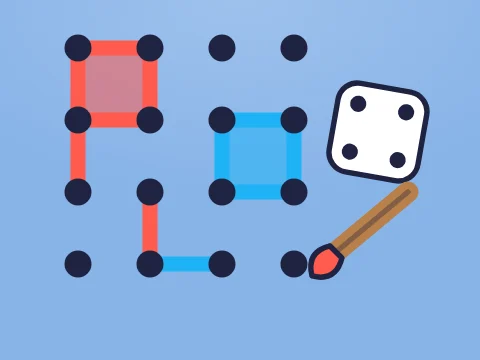
- Draw a grid of dots and take turns joining two neighbouring dots with a line.
- Draw the fourth side of a box to claim it, then draw another line.
- If your line closes nothing, your turn ends.
- Avoid drawing the third side of a box, which lets your opponent close it.
- When all lines are drawn, the player with more boxes wins.
Dots and Boxes rules
The grid
- Play on a rectangle of dots. A 5 by 5 grid of dots has 40 possible lines and 16 boxes.
- Lines run only across or down between two dots that sit next to each other. No diagonals.
A turn
- On your turn, draw one line that has not been drawn yet.
- If that line completes the fourth side of a box, the box is yours: mark it with your initial or colour, and you must draw another line.
- One line can complete two boxes at once. You claim both, and still draw just one more line.
- If your line completes no box, the turn passes. Nobody may pass a turn.
Winning
- The game ends when every line is drawn and every box is claimed.
- The player with more boxes wins. On a board with an even number of boxes, an equal split is a draw.
Dots and Boxes in Duo Clash
- The board is always 5 by 5 dots: 40 lines and 16 boxes, with no clock on a turn.
- An 8 to 8 result is not recorded. The board is replayed with the other player starting, as many times as it takes.
- There is no undo, no take-back and no pass. The line just drawn pulses in its drawer's colour so the next player can see what changed.
Dots and Boxes techniques, from first game to expert
Beginner
1. Never draw the third side early
A box with three sides drawn is a gift: your opponent closes it and moves again. While safe lines remain, always pick a line that leaves every box with two sides or fewer.
Beginner
2. Take every free box early on
In the opening and middle game, if your opponent hands you a box, take it. You lose nothing by closing it, because you still have to draw a line afterwards and can choose a safe one.
Beginner
3. Learn to see chains
As the safe lines run out, the board splits into chains: runs of boxes where drawing one line lets the other player close the whole run. A chain of 3 or more boxes is long; 1 or 2 boxes is short.
Improving
4. Open the shortest chain first
When every remaining line gives something away, give away the least. Offer a single box before a pair, and a pair before any long chain.
Improving
5. Use the double-cross to keep control
When you are handed a long chain, take all but the last 2 boxes, then draw the line at the far end that leaves those 2 boxes for your opponent as one domino. They take the 2, but then they must open the next chain for you. Giving up 2 boxes to win a long chain is usually a good trade.
Expert
6. Weigh loops before you keep control
A loop is a chain whose ends meet. Keeping control after being handed a loop costs 4 boxes instead of 2, so with small loops it can be better to take everything and give up control.
Expert
7. Count chains with the long chain rule
On a board of dots, the first player wants the number of dots plus the number of long chains to come out even; the second player wants it odd. On a 5 by 5 board of 25 dots, the first player is aiming for an odd number of long chains. Shape the board in the middle game to get the count you need.
A worked example
Late in a game on the 5 by 5 board, no safe lines are left. The undrawn lines form three chains: one of 2 boxes, one of 3 boxes and one of 5 boxes. You have 3 boxes so far and your opponent has 3. It is your turn, so you must open something.
- Open the shortest chain, the 2-box one, by drawing the line between its two boxes. Both boxes now have three sides, so your opponent takes them to lead 5 to 3 and must draw again.
- Every line left opens a long chain. Say they open the 3-chain. The greedy reply is to take all 3 boxes, but then you would have to open the 5-chain and your opponent would take all 5.
- Play the double-cross instead. Take 1 box of the 3-chain, then draw the line at the far end that leaves the last 2 boxes as a domino. Your opponent takes those 2 boxes but must then open the 5-chain, and you take all 5.
The count: you finish with 3 + 1 + 5 = 9 boxes and your opponent with 3 + 2 + 2 = 7. The greedy line in step 2 would have ended 6 to 10 against you. In the endgame, the player who decides who opens the long chains wins, and giving away 2 boxes is what that control costs.
History and variants
Dots and Boxes was first described in print by the French mathematician Édouard Lucas in 1889, who called it la pipopipette. It has been a school-notebook favourite ever since and is also known as Boxes, Squares and Pigs in a pen. The mathematician Elwyn Berlekamp studied it closely and wrote The Dots and Boxes Game, which explains chains, the double-cross and the long chain rule in depth.
Players vary the board size freely: small boards like 3 by 3 dots make quick games, while larger grids reward chain counting. Some variants let a player draw a line without being forced to move again after closing a box, and Dice Dots & Boxes replaces the extra turn with a die that sets how many lines you draw.
Where to play Dots and Boxes

Duo Clash
Two players, one phone
- Pass the phone between turns, or keep it flat between you. The background tints to the mover's colour and a banner names whose turn it is.
- Press the gap between two dots to preview a line and lift to draw it; slide off the board before lifting to cancel. The whole gap is the target, not just the thin line.
- Option: who moves first. Take turns picks at random for a new match and lets the loser start a rematch; Red first or Blue first fixes it.
- Play alone against Bolt, the bot, on Easy, Normal or Hard. Easy often gives away third sides; Normal rarely does and opens the shortest chain when it must; Hard counts chains and loops and uses the double-cross.
- Against the bot you can spend 20 coins on a hint, which highlights the line the Hard bot would draw for you. There are no hints against a friend or in a tournament.
- Dots and Boxes plays on one phone or against Bolt. It is also part of tournaments, where the first player alternates from game to game.
Questions about Dots and Boxes
Do you get another turn after closing a box?
Yes. Closing a box means you must draw another line straight away. If one line closes two boxes, you claim both and draw one more line.
How do you win Dots and Boxes every time?
No method wins every game, but strong players avoid third sides, count the long chains as the board fills and use the double-cross: in a long chain, leave the last 2 boxes for the opponent so they have to open the next chain.
Is it better to go first or second in Dots and Boxes?
It depends on the board and the play, not the seat. The long chain rule tells each player which count of long chains they want. On a 5 by 5 board of dots, the first player wants an odd number of long chains and the second player an even number.
Can Dots and Boxes end in a draw?
Yes, on a board with an even number of boxes. In Duo Clash an 8 to 8 board is not recorded and is replayed with the other player starting.
What is the difference between Dots and Boxes and Dice Dots & Boxes?
In Dots and Boxes you draw one line a turn and closing a box gives you another. In Dice Dots & Boxes a die roll sets exactly how many lines you must draw, closing a box does not add a line, and one gold box is worth 2.
Facts checked against the game's own design documents on .