How to play Hex
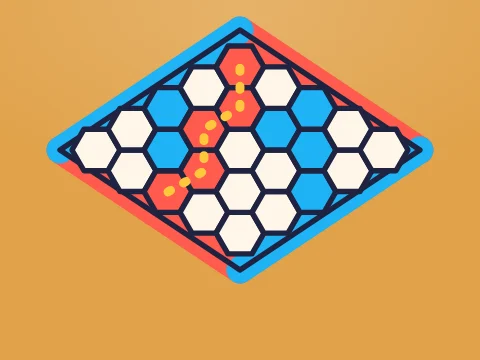
- Each player owns two opposite edges of the diamond-shaped board.
- Take turns claiming one empty hex.
- Hexes never move or get captured once placed.
- With the swap rule, the second player may take over the first hex instead of placing one.
- Join your two edges with a connected chain of your hexes to win.
Hex rules
The board
- The board is a diamond of hexagons, 7 by 7 by default (5 by 5 and 9 by 9 are options).
- Red owns the upper-right and lower-left edges; Blue owns the upper-left and lower-right. The board looks the same from both seats.
- A coin toss picks the first player of a new match; after that, the loser of each board starts the next.
Turns
- Claim exactly one empty hex. It stays yours for the rest of the board.
- No passing and no undo. The last hex placed is marked with a dot.
The swap rule
- With the swap rule on (the default), on move 2 only, the second player may take the opening hex instead of placing a new one.
- The stone moves to its mirror cell and changes to the second player's colour. That counts as move 2, and the first player moves next.
- The rule stops the opener from simply taking the strongest cell: open too strongly and it will be taken from you.
Winning
- The board ends the moment one player's chain touches both of their edges.
- There are no draws in Hex. With the optional Blocker tiles a full board without a chain is rarely possible; it is replayed.
- A match is a single board, best of 3 (default) or best of 5.
Hex tips
Start near the centre
A central hex is close to both of your edges and gets in the way of both of your rival's. It is the strongest opening, which is exactly why the swap rule exists.
Open just off-centre with the swap rule
A dead-centre opening will be swapped. Pick a decent cell away from the middle, strong enough to use but not worth stealing.
Link with bridges
Two of your hexes with two empty cells between them are effectively joined: if your rival takes one gap, you take the other.
Block from a distance
A blocker placed right against an enemy chain is easy to walk round. One placed a few cells ahead of it does far more.
Where to play Hex
Duo Clash
Two players, one phone
- The phone lies flat between you; tap an empty hex to place your stone straight away. On move 2 a Swap button appears in the second player's dock.
- Each dock shows a small road of hexes measuring how close that player's best chain is to joining their edges.
- Options: 5 by 5, 7 by 7 or 9 by 9 (larger boards on bigger phones only); single, best of 3 or best of 5. Extras: Swap rule (on), a cosmetic Blocked stamp, Bridge guides that draw dashed links between bridged hexes, and Blocker tiles, two neutral grey stones on each board.
- Bolt, the bot, counts how many hexes each side still needs. Easy plays loosely, Normal always swaps a central opening and blocks you when you are one hex away, and Hard also defends its bridges and checks your replies. A 20-coin hint rings the hex, or the Swap button, that Hard would choose.
- Hex plays online, one game per match, against a stranger or a friend by code or link, with a 30-second turn clock and no chat.
Questions about Hex
Why can't Hex end in a draw?
On a full board, one player's hexes always form a chain between their edges, because the only way to stop such a chain is to complete your own. So someone always wins.
What is the swap rule in Hex?
After the first hex is placed, the second player may take it as their own instead of moving. It keeps the first player from gaining a big advantage by opening in the centre.
Who invented Hex?
Hex was invented by the Danish mathematician and poet Piet Hein in 1942 and independently by the American mathematician John Nash in 1948, which is why it is sometimes called Nash.
Does the first player always win Hex?
In theory, the first player has a winning strategy on a board without the swap rule, but nobody knows it for larger boards. The swap rule removes that edge in practice.
Facts checked against the game's own design documents on .