How to play Kalah
- Put 4 seeds in each of the 12 pits; your row is the one nearest you and your store is on your right.
- Pick up all the seeds from one of your pits and sow them one per pit, counter-clockwise, through your store but never your opponent's.
- If your last seed lands in your store, take another turn.
- If your last seed lands in an empty pit on your side, capture it and every seed in the pit opposite.
- When one row is empty, each player banks the seeds left on their side; more seeds in your store wins.
Kalah rules
The board
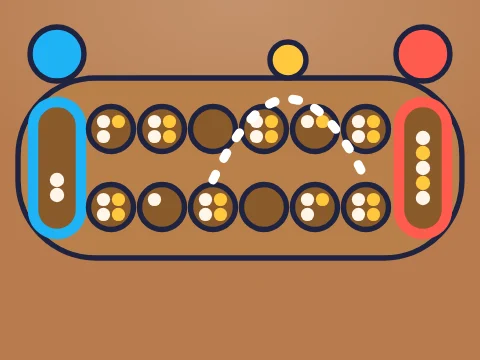
- The board has two rows of six pits. Each player owns the row nearest them and the store, sometimes called the kalah, at their right-hand end.
- Every pit starts with the same number of seeds: 4 is standard, and 3 or 6 make a shorter or longer game. Both stores start empty.
Sowing
- On your turn, choose one of your own pits that holds seeds and lift all of them.
- Drop one seed into each following pit, moving counter-clockwise: along your row, into your store, then along your opponent's row.
- Skip your opponent's store. A pit with many seeds can send you all the way round the board.
- You cannot pass, and you cannot sow from your opponent's pits.
Extra turns
- If the last seed you drop lands in your own store, you move again straight away.
- Extra turns can chain: after each one, check whether another pit now ends exactly in your store.
Captures
- If your last seed lands in an empty pit on your own side and the pit directly opposite holds seeds, take that last seed and all the seeds opposite and put them in your store.
- If the opposite pit is empty, your seed simply stays where it landed. Some rule sets capture the single seed anyway; Duo Clash does not.
- A last seed that lands in an empty pit on your opponent's side captures nothing.
The end of the game
- The game ends as soon as either row has no seeds left.
- Each player then moves every seed still on their own row into their own store.
- The player with more seeds in their store wins.
Kalah in Duo Clash
- A match is a single board or best of 3. After a decided board, the loser starts the next.
- Who starts the first board is random; on a rematch the player who lost starts.
- If both stores hold the same number of seeds, the board does not count and is replayed with the other player starting, so a match is never drawn.
- Two optional extras change the rules: Star pits, where a last seed in your own star pit also earns another turn, and Relay sowing, where a last seed in a pit that already held seeds lifts them all and keeps sowing until a seed ends in a store or an empty pit.
Kalah techniques, from first game to expert
Beginner
1. Count to your store
A pit lands its last seed in your store when its seed count equals its distance from the store. With 4 seeds at the start, the third pit from your left does exactly that, which is why it is the classic first move.
Beginner
2. Play the pit nearest your store first
When two pits can both reach your store, sow the one closer to it first. That move drops no seeds into the farther pit's path, so the farther one still lines up for a second extra turn.
Beginner
3. Chain your extra turns
After every extra turn, count again. A pit that just received a seed may now end exactly in your store, and two or three extra turns in a row often decide a game.
Improving
4. Watch both rows for empty pits
An empty pit on your side facing a full pit is a capture you might make. An empty pit on your opponent's side facing a full pit of yours is a capture they might make. Check both before every move.
Improving
5. Do not feed easy extra turns
Seeds you sow into your opponent's row change their counts. Before a long sowing, check whether it gives one of their pits the exact number to reach their store.
Expert
6. Protect your big pits
A large pile of seeds is a target if the pit opposite is empty and reachable. Either spend the pile, or keep the opposite pit filled so your opponent cannot land there.
Expert
7. Count the endgame
When few seeds remain, add up both rows. Seeds on your side at the end are yours, so emptying your own row early can hand everything left on your opponent's row to them.
A worked example
Number your pits 1 to 6 from left to right, with your store just past pit 6. Your opponent’s pits run 1 to 6 from their left, so their pit 1 sits opposite your pit 6. Every pit starts with 4 seeds.
- Your pit 3. Its 4 seeds go into pits 4, 5 and 6 and the last one into your store. Store 1, and you go again.
- Your pit 6. It now holds 5 seeds: 1 into your store and 4 into your opponent’s pits 1 to 4. Store 2, and your turn ends. This move feeds your opponent: their pit 2 now holds 5 seeds, exactly enough to reach their store.
- Your opponent takes that extra turn from their pit 2, then sows their pit 6. Its 5 seeds go into their store and your pits 1 to 4. Your row now reads 5, 5, 1, 6, 5, 0, and their pit 1, opposite your empty pit 6, holds 5 seeds.
Now look for the chain. Your pit 2 has 5 seeds and is 5 steps from your store, so play it first: store 3, go again. That drops a seed into pit 6, which now holds 1 and is 1 step from the store: play it, store 4, go again. Pit 6 is empty once more, and your pit 1 has 5 seeds, exactly enough to reach it. Sow pit 1 and the last seed lands in the empty pit 6, capturing itself and the 5 seeds opposite. Your store jumps to 10 while your opponent’s holds 2.
The order mattered. Sow pit 1 first and you still capture, but the seed it drops into pit 2 spoils that pit’s extra turn, and you finish on 8 instead of 10.
History and variants
Mancala is a family of sowing games played for centuries across Africa, the Middle East and South and Southeast Asia, with well-known relatives such as Oware and Bao. Kalah is a modern member of the family, introduced in the United States in the mid-20th century by William Julius Champion Jr., and it is the version most people outside Africa learn as mancala.
Common variations change the number of seeds per pit, whether a capture needs seeds in the opposite pit, and whether sowing continues from a full pit, which many apps call avalanche mode. Duo Clash offers the seed counts and relay sowing as options and keeps the classic capture rule.
Where to play Kalah
Duo Clash
Two players, one phone
- Two players sit face to face around the phone; tap one of your pits to sow it. Every pit shows its seed count as a number facing its owner, and tapping a pit you cannot play just shakes it.
- Options: 3 (Quick), 4 (Classic) or 6 (Long) seeds per pit, a single board or best of 3, plus the Star pits and Relay sowing extras and a cosmetic streak flame for extra turns in a row.
- Play alone against Bolt, the bot, on Easy, Normal or Hard. Easy plays a random pit about half the time, Normal looks a few moves ahead, and Hard looks deep and rarely slips.
- Against the bot you can spend 20 coins on a hint that rings the strongest pit for 2 seconds without sowing it.
- Kalah also plays online, one game per match, against a stranger who shows only a random name and flag or a friend invited with a code or link. Each turn has a 30-second clock, and an extra turn starts a fresh clock. There is no chat.
- In a tournament it is always a single board with 4 seeds per pit and the extras at their defaults, with no hints.
Questions about Kalah
Is Kalah the same as mancala?
Mancala is the name of a whole family of sowing games. Kalah is one member of that family, and it is the version usually sold and played as mancala in North America and Europe, with six pits a side and a store at each end.
How do you win mancala?
Finish with more seeds in your store. Most seeds come from extra turns, captures from empty pits, and the seeds left on your own row when the game ends, so plan moves that land in your store and keep your big pits safe.
Is it better to go first or second in mancala?
Going first is an advantage in standard Kalah. Computer analysis has shown that the 6-pit, 4-seed game is a win for the first player with perfect play. In Duo Clash the starter of the first board is random, and after that the loser of each board starts the next.
Can you play mancala by yourself?
Kalah needs two players, but in Duo Clash you can play it alone against Bolt, the bot, on Easy, Normal or Hard, or online against another person.
What is avalanche mode in mancala?
It is the name many apps give to relay sowing: when your last seed lands in a pit that already has seeds, you pick them all up and keep sowing. In Duo Clash this is the optional Relay sowing extra; the classic game stops sowing after the last seed.
What happens when one side of the board is empty?
The game ends at once. The player who still has seeds on their row moves them into their own store, then both stores are counted.
Facts checked against the game's own design documents on .