How to play Nine Men's Morris
- Take turns placing your 9 pieces on empty points.
- Make a line of three, called a mill, and remove one rival piece.
- With all pieces placed, slide one piece a turn along a line to an empty neighbour.
- Down to three pieces, fly a piece to any empty point.
- Win by leaving your rival 2 pieces or no legal move.
Nine Men's Morris rules
The board and setup
- The board has three squares, one inside another, joined by lines at the middle of each side. Pieces stand on the 24 points where lines meet or turn.
- Each player has 9 pieces of one colour, all in hand at the start. The board starts empty.
Phase 1, placing
- Players take turns putting one piece from hand onto any empty point.
- Placing continues until both players have placed all 9, even if mills are formed along the way.
Phase 2, sliding
- When your hand is empty, a turn is sliding one of your pieces along a line to the next point, which must be empty. Pieces never jump.
- If you have no legal slide at the start of your turn, you lose.
Phase 3, flying
- A player with exactly 3 pieces left may fly: move any one piece to any empty point on the board.
- Flying is part of most modern rule sets, including Duo Clash's. Some older rules leave it out; agree before you play.
Mills and removing pieces
- A mill is 3 of your pieces on one straight line: along a side of any square, or along one of the 4 lines that join the squares.
- Forming a mill, by placing, sliding or flying, lets you remove one of your rival's pieces from the board at once. Removed pieces never return.
- You may not remove a piece that is part of a mill, unless every one of your rival's pieces is in a mill. Then any of them can go.
- Opening a mill by sliding a piece out, then closing it again on a later turn, counts as a new mill each time.
Winning
- Your rival loses when they have only 2 pieces left, or when it is their turn and they have no legal move.
Nine Men's Morris in Duo Clash
- Who starts is decided by a coin toss; after that the loser of a game starts the next one.
- If 50 slides pass with no piece taken, the game is a stand-off: it is replayed and does not count. A match never ends drawn.
- Two optional extras for the Six and Nine boards: Corner diagonals adds lines joining the corners of the squares, and Double mill takes two lets one move that closes two mills remove two pieces.
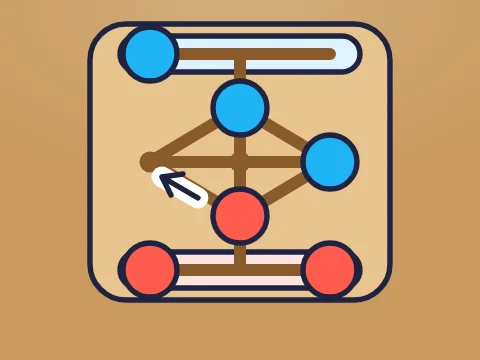
- Three Men's Morris (a 3 by 3 grid with diagonals, 3 pieces each, first mill wins) and Six Men's Morris (two squares, 16 points, 6 pieces, no flying) are on the Board option.
Nine Men's Morris techniques, from first game to expert
Beginner
1. Claim the crossing points
The middle point of each side of the middle square connects to 4 neighbours, more than any other point. Pieces there can join more lines and are harder to trap once sliding begins.
Beginner
2. Do not rush mills while placing
A mill in the first few placements removes one piece, but it often leaves your other pieces clumped and short of moves. Mobility decides the sliding phase, so spread out first.
Beginner
3. Block every two-in-a-row
When your rival has 2 pieces on a line with the third point empty, block it unless you can make a mill of your own this turn. Each unblocked pair is a piece you will lose.
Improving
4. Set up a double threat
Place pieces so one more placement or slide would complete either of two different mills. Your rival can block only one, and you take a piece with the other.
Improving
5. Build a running mill
In the sliding phase, aim for a piece that can slide out of a mill into another ready-made line, then back again. Each move closes a mill and takes a piece, and your rival can rarely stop it.
Expert
6. Count your rival's moves
Taking pieces is not the only way to win. If their pieces are boxed in, block the last free point near them and they lose on the spot with no legal move.
Expert
7. Fear the flyer
When your rival is down to 3, they can land anywhere, so every pair of yours with an empty third point is blocked instantly. Keep your own open lines few, and close one only when you can take a piece at once.
A worked example
To follow the moves, name the three squares outer, middle and inner, and name points on each square by compass direction: N is the middle of the top side, NE the top-right corner, and so on. The lines joining the squares run through N, E, S and W.
- White places on middle N, the strongest point on the board: it sits on the middle square’s top side and on the line joining all three squares.
- Black takes middle S for the same reason.
- White places on middle E. If White also gets middle NE, it will hold two pairs at once: middle NW would then complete the top side and middle SE the right side, and Black could block only one.
- Black sees the danger and places on middle NE, blocking both lines through that corner at once.
- White switches to the cross line and places on outer N. Outer N and middle N are now 2 in a row on the line through all three squares, and inner N is empty.
- Black must block, and places on inner N.
- White places on outer E, making a second cross-line pair with middle E. Black blocks on inner E.
After these moves White has forced Black to place pieces on the inner square, where they connect to fewer neighbours, while White’s pieces sit on well-connected points. No mill has been made, yet White is ahead: in the sliding phase, White will have more moves and more ways to open and close lines. This is why strong players care more about position than early captures.
History and variants
Nine Men’s Morris is one of the oldest board games still played. Boards for it have been found carved into stone and wood in many places across Europe, and the game was widely played in the Middle Ages. Shakespeare mentions “the nine men’s morris” in A Midsummer Night’s Dream. In German it is called Mühle and in English it is also known as Mill or Merels.
Smaller relatives use the same idea: Three Men’s Morris on a 3 by 3 grid, and Six Men’s Morris on two squares. Some players add diagonal lines through the corners, which creates extra mills. In the 1990s, computer analysis showed that Nine Men’s Morris is a draw when both players play perfectly, so a well-matched game is decided by mistakes.
Where to play Nine Men's Morris
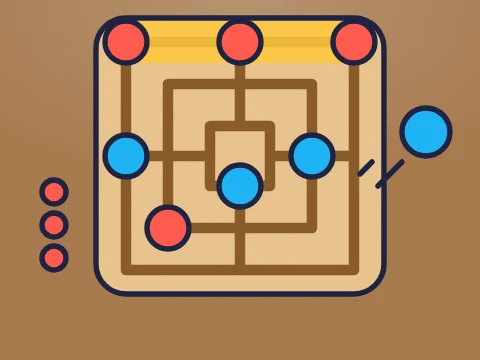
Duo Clash
Two players, one phone
- Two players face each other across one phone. Tap an empty point to place; later tap one of your pieces, then a pulsing point to slide or fly. After a mill, the rival pieces you may take wiggle.
- Options: Board (Three, Six or Nine, default Nine), Games (single, best of 3 or best of 5), Corner diagonals, Double mill takes two, and Call-outs, which only add a sound and a flame for mills.
- Against Bolt the bot: Easy looks only at its own move and plays at random half the time, Normal checks your best reply, and Hard looks a turn further ahead and rarely slips.
- Against the bot, 20 coins buys a hint that rings the best point, piece or capture for 2 seconds. There are no hints with a friend, online or in a tournament.
- Nine Men's Morris plays online against a stranger or a friend you invite by code or link. An online match is one game, with a 30-second clock on each turn.
- A tournament game is always the Nine board, a single game, with base rules.
Questions about Nine Men's Morris
Can you take a piece out of a mill in Nine Men's Morris?
Not normally. Pieces in a mill are protected, unless every one of your rival's pieces is in a mill, in which case you may take any of them.
What is flying in Nine Men's Morris?
When a player is down to exactly 3 pieces, they may move a piece to any empty point instead of sliding it. Most modern rules use flying; some older ones do not.
Can you make the same mill twice?
Yes. Slide a piece out of a mill and back in on a later turn and it counts as a new mill, so you remove another piece.
Can Nine Men's Morris end in a draw?
With perfect play from both sides, yes; it has been calculated to be a draw. In casual play, groups often call a draw after many moves without a capture. Duo Clash replays such a game, so a match always has a winner.
How many pieces do you need to win Nine Men's Morris?
You win when your rival has only 2 pieces left, since they can no longer make a mill, or when they cannot move on their turn.
What is the difference between Three, Six and Nine Men's Morris?
The board size and piece count. Three Men's Morris is a 3 by 3 grid where the first mill wins; Six Men's uses two squares and 6 pieces with no flying; Nine Men's uses three squares and 9 pieces.
Facts checked against the game's own design documents on .