How to play King's Escape
- One player takes the king and his guards in the middle; the other takes the army around the edges.
- The army moves first; pieces slide any distance along a row or column.
- Trap an enemy piece between two of yours to capture it.
- The king wins by reaching a corner; the army wins by trapping the king.
- Swap sides and play again; win both boards, or win faster.
King's Escape rules
Setup
- On the 7 by 7 board the army has 8 pieces and the king has 4 guards. On 9 by 9 it is 16 and 8, and on 11 by 11 it is 24 and 12.
- The king starts on the throne, the centre square, with his guards in a cross beside him. The army stands in T-shapes in the middle of each edge.
- A coin toss decides who holds the king first. Sides swap for the second board of the pair.
Moving
- Move one piece any number of empty squares in a straight line along a row or column. No jumping, no diagonals, no passing.
- Only the king may stop on the throne or pass through it, and only the king may stop on a corner.
Capturing
- Trap an enemy piece between the piece you just moved and another of yours on the same line, and it is removed. One move can capture several pieces.
- A corner, or the empty throne, counts as one of your pieces for capturing.
- Moving into a gap between two enemies is safe: only the moving side captures.
- With Armed king on (the default), the king can help his side capture.
Capturing the king
- Away from the throne, the king is taken like any piece, by two attackers on one line.
- On the throne or beside it, he must be surrounded on all four sides; the empty throne counts as one side. With Strong king on, four sides are needed everywhere.
Winning
- The king's side wins when the king stops on a corner. The army wins when the king is captured. A side with no legal move loses.
- Win both boards of a pair to take it. If you win one each, the faster win (fewer total moves) takes the pair; equal move counts replay the pair.
- Boards that run past a move limit (80 on 7 by 7, 120 on 9 by 9, 160 on 11 by 11) are replayed.
King's Escape tips
King, leave the throne early
A king with open lanes toward two different corners cannot be blocked in a single move. Get him moving before the army closes in.
Army, guard the corners first
Holding the squares diagonally next to each corner leaves the king nowhere to land. Build those blocks before you chase him.
Use corners and the throne as anvils
Since they count as your pieces, an enemy standing next to a corner or the empty throne needs only one of your pieces to capture.
Play for speed when split
If the pair may end one board each, the quicker win takes it. When you hold the king, a fast escape beats a slow grind.
Where to play King's Escape
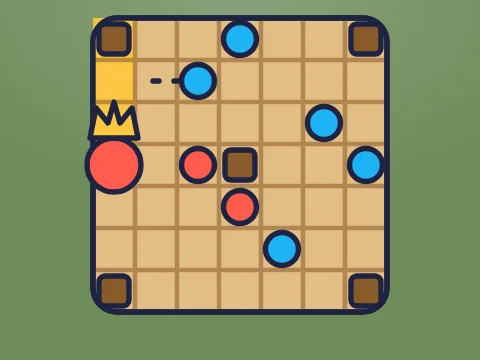
Duo Clash
Two players, one phone
- The phone lies flat between you. Tap a piece to lift it and every reachable square pulses; tap one to slide there, or drag the piece. There is no undo, so the lift is your moment to check.
- Options: 7 by 7, 9 by 9 or 11 by 11 (larger boards on bigger phones); 1 pair or best of 3 pairs. Extras: Open lanes glow, which marks every clear line from the king to a corner (on); Armed king (on); Strong king; and Edge escape, an easier version where any edge square is an escape.
- Bolt, the bot, plays whichever side it holds and values open lanes for the king most. Easy plays many random moves, Normal always takes a winning move but looks only one move ahead, and Hard checks your best reply. A 20-coin hint shows the move Hard would make for you.
- King's Escape plays online, one game per match, with a 30-second turn clock and no chat.
Questions about King's Escape
Is King's Escape the same as Hnefatafl?
It belongs to the same tafl family. Hnefatafl usually means the large 11 by 11 game; King's Escape offers 7 by 7, 9 by 9 and 11 by 11 boards with rules close to the common modern reconstructions.
Can the king capture?
With Armed king on, which is the default, yes: the king can be the moving piece or the far piece in a capture. Turn it off and he cannot.
Where does tafl come from?
Tafl games were played in Scandinavia and the wider Norse world from at least the Viking Age. The original rules were never written down in full, so the rules played today are reconstructions.
Facts checked against the game's own design documents on .