How to play Tic Tac Toe
- Decide who plays X and who plays O.
- Take turns placing your mark in any empty square.
- Get three of your marks in a line across, down or corner to corner.
- Block your opponent whenever they have two in a line with the third square empty.
- If the grid fills with no line, the game is a draw.
Tic Tac Toe rules
The board and marks
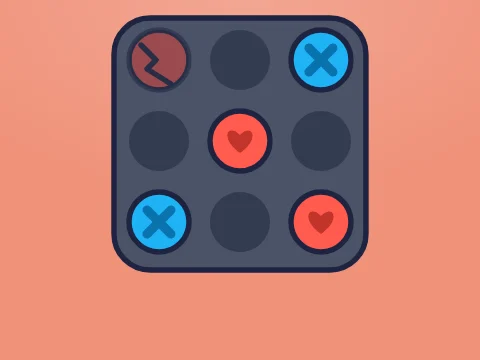
- The board is a 3 × 3 grid of nine squares, empty at the start.
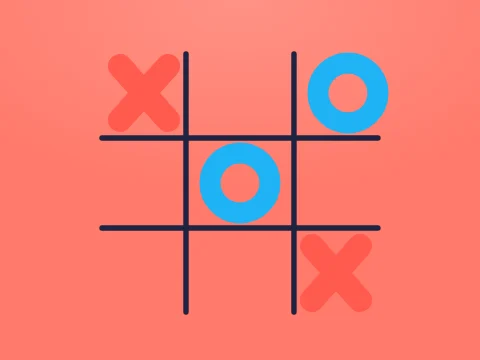
- One player places X (a cross) and the other places O (a nought). In Duo Clash, Red plays crosses and Blue plays noughts, and the marks never swap during a match.
A turn
- Players alternate, placing one mark per turn in any empty square.
- A mark stays where it is placed for the rest of the game. You can't move or remove it, and you can't pass.
Winning
- Three of your marks in a straight line win: any of the 3 rows, the 3 columns or the 2 diagonals. That's 8 possible lines.
- A move that fills the last square and also completes a line is a win, not a draw.
- One move can complete two lines at once; it is still a single win.
Draws
- If all nine squares are filled and nobody has a line, the game is a draw.
- In Duo Clash a drawn game is replayed and doesn't count toward the match, and the player who didn't start it starts the replay.
Tic Tac Toe techniques, from first game to expert
Beginner
1. Win, then block, then build
Every turn, check in this order: can you complete three right now? Can your opponent complete three on their next move? Only when both answers are no should you make a building move.
Beginner
2. Going first, take a corner or the centre
The centre is part of 4 lines and each corner of 3, against 2 for an edge square. A centre opening is safe. A corner opening sets the most traps, because the natural-looking replies on an edge or another corner lose.
Beginner
3. Going second, answer a corner with the centre
If your opponent opens in a corner, take the centre at once. Any other reply lets a careful first player force a win. If they open in the centre, take a corner, never an edge.
Improving
4. Make a fork
A fork is one move that creates two lines of two at once, each with its third square empty. Your opponent can block only one, so you complete the other. Almost every won game of tic tac toe is won with a fork.
Improving
5. See the fork coming
Before you block, ask what your opponent's next move could fork. Often the best block is a move that also makes a threat of your own, so they must answer you instead of forking.
Improving
6. Against opposite corners, play an edge
If you are O with the centre and X holds two opposite corners, play an edge square, not a corner. An edge forces X to block you, and the game heads for a draw; a corner lets X fork.
Expert
7. Aim for the draw against perfect play
Tic tac toe is solved: when both players make no mistakes, every game is a draw. Against a strong player or a hard bot, a draw is the correct result, and wins come from the other side's slips.
Expert
8. On 4 × 4, fight for the middle
Duo Clash's 4 × 4 board needs four in a row, and only the two long diagonals count. The four middle squares sit on the most lines, so contest them early, and block any row or column the moment it reaches three.
A worked example
Number the squares like a phone keypad: 1, 2, 3 across the top, 4, 5, 6 in the middle and 7, 8, 9 along the bottom. X moves first.
Game 1: a corner opening punishes an edge reply.
- X plays 1, the top-left corner.
- O plays 2, the top edge next to it. This looks like a block, but it is the losing move.
- X plays 5, the centre. X now has 1 and 5 on the diagonal and threatens to win on 9.
- O must play 9 to block. O’s marks on 2 and 9 share no line, so O makes no threat of its own.
- X plays 7. Now X has two lines of two at once: 1 and 7 down the left column (waiting for 4), and 7 and 5 on the other diagonal (waiting for 3). This is a fork.
- O can block only one. Whichever O picks, X plays the other and wins.
Game 2: the same opening, defended properly.
- X plays 1.
- O plays 5, taking the centre, which is the only safe reply to a corner.
- X plays 9, the opposite corner, hoping for a mistake.
- O plays 2, an edge. Playing a corner here (3 or 7) would lose to a fork. The edge makes a threat instead: O has 2 and 5 and wants 8.
- X must block on 8. That gives X 8 and 9 on the bottom row, so X threatens 7.
- O blocks on 7, which gives O 7 and 5 on a diagonal: now O threatens 3.
- X blocks on 3, which lines up 3 and 9 down the right column: X threatens 6.
- O blocks on 6, and now O has 4, 5, 6 in sight with only 4 left empty, so X takes 4 to block.
The board is full, nobody has a line, and the game is drawn. Every move after move 3 was a forced block, and that chain of forced moves is exactly how a correct defence holds the draw. The difference between the two games is one square on move 2.
History and variants
Tic tac toe is one of the oldest and best-known pencil-and-paper games. Noughts and crosses is its usual British name, and tic-tac-toe the usual American one. It was also one of the first games played on a computer: OXO, written in 1952 by A. S. Douglas for the EDSAC computer at Cambridge, played noughts and crosses against a person.
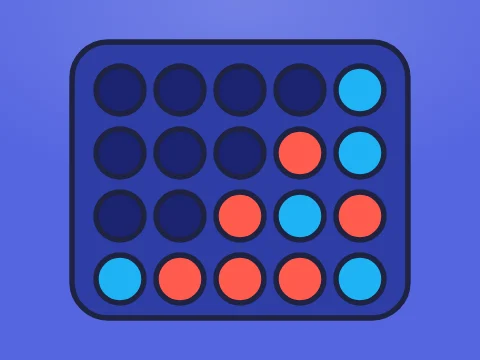
Because the game is so small, it has been solved completely: with best play from both sides, every game is a draw. That is why people who play often move on to versions that are harder to exhaust. Duo Clash’s own 4 × 4 board needs four in a row, with only the long diagonals counting. Fading Tic Tac Toe gives each player only three marks on the board, and your oldest one disappears when you place a fourth, so a draw by a full board can’t happen. 4 in a Row adds gravity and a bigger board to the same race to a line.
Where to play Tic Tac Toe
Duo Clash
Two players, one phone
- Two players pass one phone back and forth; tap an empty square to place your mark. A countdown before each game names who starts.
- A match is best of 3, 5 or 7 games, with best of 5 as the default. The first starter is picked at random, and after that whoever lost a game starts the next.
- Play on the classic 3 × 3 board or a 4 × 4 board, where you need four in a row and only the two long diagonals count.
- A game is drawn only when the board is full. A draw is replayed, so every match ends with a winner.
- There's no turn timer when you play on one phone.
- Play solo against Bolt, the bot, on Easy, Normal or Hard. Bolt on Hard is close to perfect on 3 × 3, so most good games against it end drawn.
- Against Bolt, outside a tournament, you can spend coins on a hint: it highlights a square, one hint per turn, and never places the mark for you.
- Tic Tac Toe plays online too, turn by turn, against a stranger (shown only by a random name and a flag, with no chat) or a friend you invite by code or link. Online, a match is one game, each turn has a 30-second clock, and two timeouts forfeit.
- In a tournament it is always best of 5 on the 3 × 3 board, with hints off.
Gridwise
Logic puzzles in one calm app
- Gridwise includes Tic Tac Toe as a one-player game with its own path of 300 levels.
- Each level takes about a minute, and it works with no connection.
Questions about Tic Tac Toe
How do you win Tic Tac Toe every time?
You can't against a player who makes no mistakes, because perfect play from both sides always ends in a draw. You can make sure you never lose, and win whenever your opponent slips, by blocking every two-in-a-line and setting up forks.
How do you win Tic Tac Toe going first?
Open in a corner. If your opponent replies anywhere but the centre, you can force a fork and win. If they take the centre, play the opposite corner and wait for a mistake.
How do you win Tic Tac Toe as player 2?
Against a perfect first player you can only draw, so play not to lose: take the centre after a corner opening, a corner after a centre opening, and block every threat. Then punish any slip with a fork of your own.
Is Tic Tac Toe the same as noughts and crosses?
Yes. Noughts and crosses is the British name for the same game, and X and O is another common name.
What is the trick to Tic Tac Toe?
The fork: one move that makes two lines of two at once. Your opponent can block only one of them. Setting up forks, and stopping your opponent's, is the whole strategy.
Facts checked against the game's own design documents on .